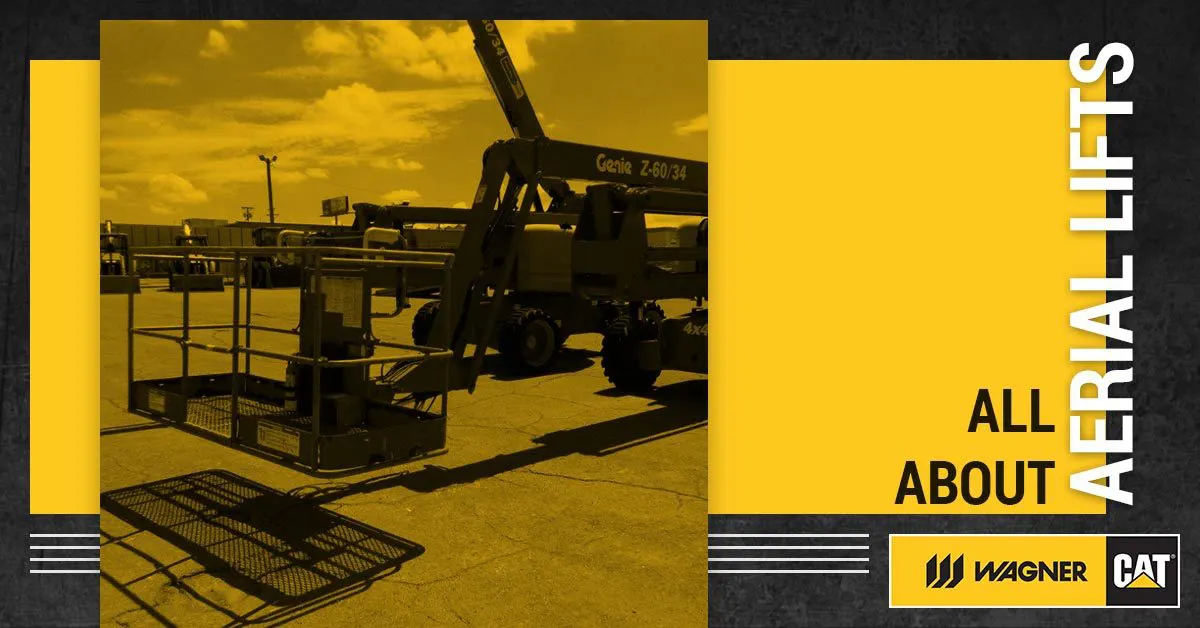
Aerial lifts are a marvelous piece of heavy equipment used on many job sites and for various projects. However, due to improper operation and lack of know-how, their use results in a significant number of injuries and deaths every year.
In this blog, we’ll review the defining criteria of aerial lifts, the primary hazards of the machine, how to avoid safety issues with aerial lifts, and then we’ll end with the best practices for operating this construction equipment tool — when properly employed, of course!
For more information on aerial lifts, OSHA-approved safety techniques, or general inquiries about heavy construction equipment resources, please reach out to Wagner Used Equipment today.
What is an Aerial Lift?
Simply put, an aerial lift is a piece of heavy equipment used in construction that serves to elevate site workers and project personnel to high-vertical or hard-to-access areas of the setting. Aerial lifts may operate through the supplementary employment of extendable boom platforms, vertically oriented towers, aerial ladders, or some combination of these and other components.
Potential Hazards of Aerial Lifts
As with any piece of heavy construction equipment, there are certain hazards potentially associated with the aerial lifts. According to OSHA, the Occupational Safety and Health Administration, there are a number of dangers that may occur during operation. These include:
- Falling objects
- Entanglement with wires and parts
- Forceful contact with heavy objects
- Destruction of overhead and ceiling structures
- Equipment tipping over while in use
- Structural issues and failures (e.g. collapses)
- Unintentional ejection of operator from lift platform
- Electrocution (electrical shock)
As you can see from this lengthy but certainly not exhaustive list, there are quite a few hazards of which any aerial lift operator must remain cognizant.
Training to Avoid Aerial Lift Hazards
With so many potential dangers, how does a prepared construction equipment operator train to avoid them?
Understanding the safest and most proper use of an aerial lift begins by understanding the hazards themselves, whether these pertain to electrical, structural, or sizeable-object components.
Furthermore, the likelihood of aerial lift hazards increases correspondingly with the unsafe conditions present on a work site. These hazardous conditions are countless, but common ones include fluid leaks, undercharged batteries, brake failures, and loose or missing parts. Be sure to perform a thorough inspection of every piece of aerial lift equipment prior to operation, as well as to familiarize all operators with the manufacturer’s requirements.
If something does go wrong during the use of this heavy equipment, make sure that supervisors and workers are aware of the procedure for how to respond and mitigate any damage that may follow from the malfunctioning.
If an issue does occur, the responsible operator should be retrained as soon as possible so as to prevent future injuries or accidents.
Best Practices for Aerial Lift Operation
Now that we understand the risks of using an aerial lift, we’ll discuss the procedures for best-practice operation of the heavy equipment.
Prior to initiating any functional operation of the aerial lift, you’ll want to conduct a thorough pre-start inspection. If any malfunctions or unfixed repairs are apparent, remove the lifts from the construction site until these issues can be corrected.
Once the pre-inspection checklist is completed and the work zone is cleared of hazards and obstructions, the aerial lift can begin to be safely operated.
Since aerial lifts elevate the user to considerable heights, whether on scaffolding or a skyscraper, all equipment operators must be protected from falls. Body harnesses or restraining belts should be worn at all times and movements to climb out or reach out of the lift to unreasonable distances should never be attempted. Overhead protection is a must.
It’s equally crucial to mind the load capacity of a given aerial lift manufacturer, whether it is a CAT product or something else, so as to avoid overriding or damaging the mechanical, hydraulic, and electrical systems of the machine.
Lastly, the work zone should be properly equipped with protective and functional gear, including wheel chocks, warning signs and cones, and outrigger pads.
Conclusion
In this article, we’ve briefly reviewed the safety precautions and procedures that must be implemented during the use of an aerial lift. For more information on construction training, work site safety, and other useful information about heavy construction equipment, please refer to the resources available at Wagner Used Equipment.