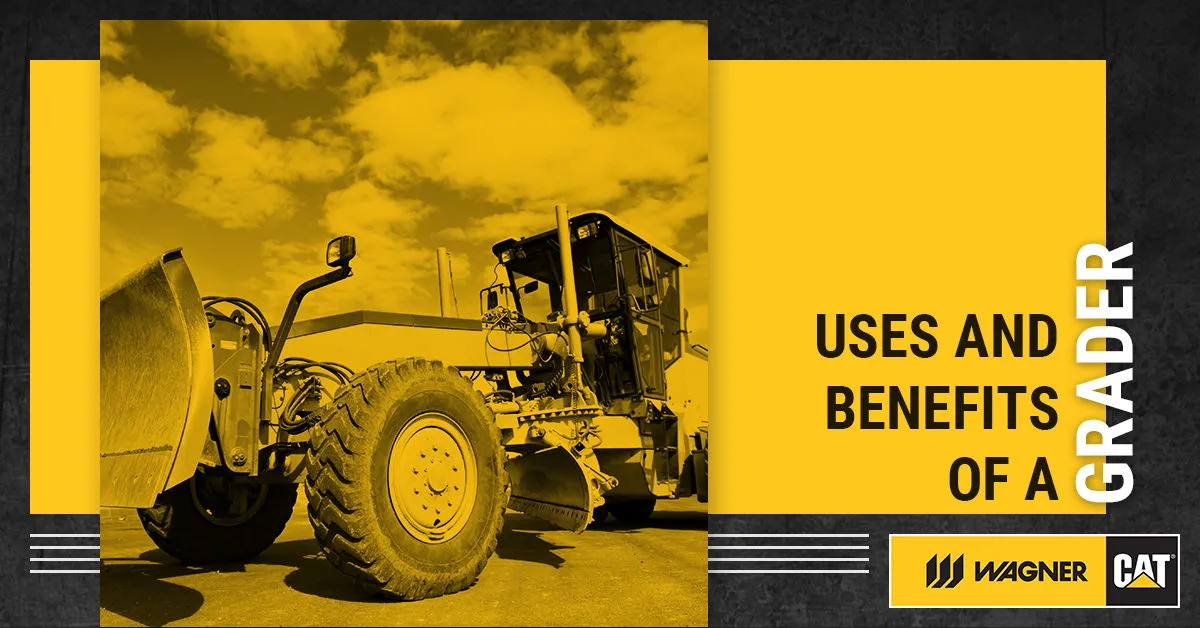
In the world of construction, there are more than a few options when it comes to heavy machinery. But if you’re given a specific task that requires the smoothing and leveling of a surface, there are few better options than the old reliable grader.
In this article from Wagner Used Equipment, we’ll review the uses and benefits of this nifty piece of equipment. Read on to learn more about graders, and check out our extensive inventory of construction machinery!
 What is a Grader?
A grader, also known as a road grader or a motor grader, is a piece of self-propelled heavy construction equipment used for the creation of flat surfaces. It’s most commonly used during the grading phase of a project, during which the surface of future construction is precisely leveled and refined to meet certain specifications.
 How does a grader work?
Graders function by way of three axles, with two in the rear and one in the front. Traditional models were moved with attached equipment or simply by horses, but modern machines are either self-propelling thanks to axles, or they contain an engine — this is why they’re sometimes called “motor graders.” Steering is executed by way of a joystick or a steering wheel.
Graders also feature a blade between the axles, and some are equipped with a second blade. Some models may allow for the attachment of supplementary arms, diversifying the number of completable tasks.
 What can a grader do?
As a result of recent innovations and improvements in graders, the uses of these machines have increased.
Originally, graders were used for paving and maintaining roads made of dirt or gravel. This is accomplished with the blade, which flattens the underlying terrain to produce a flat surface.
Although motor graders are typically used to produce roads, they can create level surfaces to be used for a variety of purposes.
For instance, a grader may be used to even out the foundation of a construction site prior to breaking ground, or on an unpaved parking lot before applying asphalt. Graders can also be employed for the widening and initial production of ditches and trenches. Perhaps the real magic of the grader comes in its unparalleled ability to maintain and polish up previously wrecked roads that have been corrugated or damaged by heavy traffic.
If specialized attachments are added to the grader, its versatility increases. Snowy environments can be plowed. Concrete can be spread to form new walkways. Soil can be leveled out to prep it for the planting season.
A grader can also be used for a process known as scarifying. This refers to the procedure by which a top-level layer of soil is removed, then resurfaced with a new material, like asphalt, gravel, or another aggregate.
 Impact of Site on Grader Used
The kind of grader that is used on a site will vary depending on the type of material being worked with and the dimensions of the work space. For example, smaller spaces with less room to turn may necessitate the use of a single-axle, articulated frame grader, whereas wider spaces with more work to accomplish will depend on the power of a multi-axle machine.
Conclusion
This concludes our brief overview of the uses and benefits of
the grader. A mighty machine as heavy as it is useful, countless professionals in the construction industry are undoubtedly grateful for this feat of engineering and its ability to drastically facilitate their work tasks.
To read more about uses and benefits of other construction, agricultural, and industrial pieces of machinery, please explore the rest of the blogs available right here at Wagner Used Equipment.